DomoTick
The house that uses its own sun: a local home-automation hub, tailored to each home — here, mine.
About
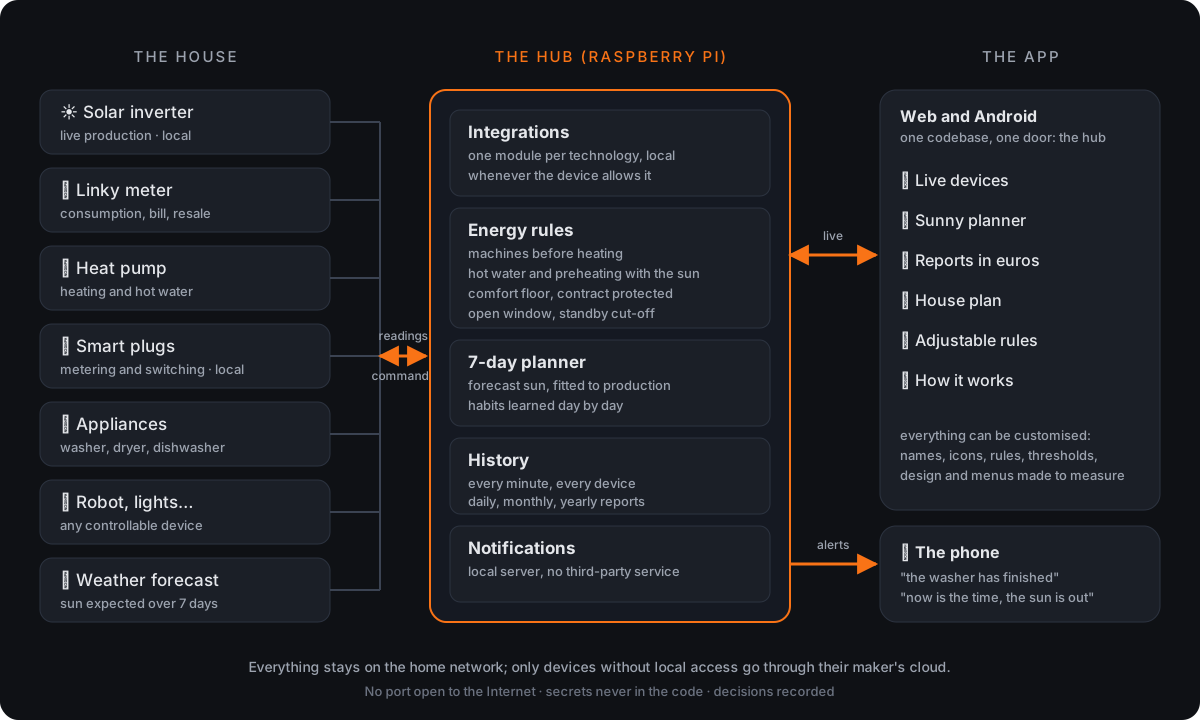
DomoTick is a home-automation system written from scratch in Rust: a hub on a Raspberry Pi that talks directly to every device, and an app (web and Android) that only talks to the hub. Its goal is not to switch lamps from a phone but to use energy at the right time.
Tailored to each home
DomoTick is not an off-the-shelf product: each setup is built for one house, with its devices, its electricity contract and the habits of the people living there. What follows, screenshots included, is an example: DomoTick as it runs in my own home.
One app instead of fifteen
Inverter, battery, heat pump, plugs, charger, alarm: every brand has its own app, and a household ends up with fifteen icons that never talk to each other. DomoTick replaces them all with a single app that shows only what the home needs and makes the devices work together. Nor is it a general-purpose platform to set up screen by screen: the app is built for this home, and the family uses it without any training.
Using your own sun
The hub reads live the solar panels' production (inverter over Modbus TCP), the heat pump's counters, the smart plugs and the Linky meter, then applies the house rules: the machines come before the heating, the hot-water tank heats during the day with the sun, the heating preheats with the surplus without dropping below a comfort floor, and the 6 kVA contract is protected.
A planner that learns
A seven-day planner puts the washing machine, the dryer and the dishwasher on the sunniest hours, learning the family's habits day by day. The phone tells you when a machine has finished or when it is time to start a cycle, and every evening a report says what the sun saved.
Secure by design
The data stays in the house and the hub opens no port to the Internet. Every exchange with a device is authenticated, and encrypted wherever the protocol allows it. Passwords and keys are stored on the Raspberry Pi only, never in the code or the logs. When needed, the hub can be reached from outside the house through an extra security layer (an encrypted private network, VPN-style), without ever being exposed directly to the Internet.
Highlights
- Everything is set from the app: device names and icons, favourites, filters, the house plan, energy rules and thresholds, notifications, tariffs; and since the code is mine, the design, the menus and who can reach them are tailored to each household
- Secure by design: no port open to the Internet, data kept at home, token-protected app, encrypted and authenticated exchanges with the devices (a frame with a wrong signature is rejected), keys and passwords never in code or logs, Rust with no 'unsafe' code
- Rust hub (axum, SQLite), Dioxus app built for the web and Android: one UI codebase
- Hand-written integrations: Tuya plugs locally (encrypted 3.4/3.5 protocol), SolarEdge inverter over Modbus TCP, Atlantic heat pump through Overkiz, SmartThings washer, Roomba over MQTT/TLS, Linky through Enedis, Open-Meteo weather
- Energy rules: machines before heating, comfort floor and ceiling, solar preheating, an 'open window' button, auto-off of idle plugs
- Hot water by the sun: a midday heating window, a top-up before the morning shower, a weekly anti-legionella boost on a sunny day
- Seven-day planner: solar forecast fitted to the real production, habits learned per weekday, washing-then-drying chains
- Local notifications through an ntfy server on the Pi and an Android service built into the app, with no third-party cloud
- Reports: the month's bill from the Linky, today's self-consumption and resale, history 2023-2026
- Every architecture decision, security included, is written down with its reasons (ADRs): you know why the system is built this way
How it works